
Research Program Overview


The East-West Center Research Program provides rigorous and critical analysis of key regional issues of common concern to the Asia Pacific region and the U.S. including policy analyses that address these issues. It is a source of regional expertise in support of the Center’s programs. Collaborative research promotes better relations and understanding among the nations of the region and the U.S. and contributes to both capacity and institution building.  Work is organized into four study areas: Economics; Environmental Change, Vulnerability, and Governance; Politics, Governance and Security; and Population and Health.

Highlights

The Asian International Justice Initiative (AIJI) recently began work in Cambodia on several projects.  One of the projects involves a video outreach project that is showing on Cambodian prime time TV.  It is designed to raise the level of understanding of the People of Cambodia regarding the tribunals that are scheduled for later 2007. 

Another project is the training of the prosecution and defense counsel of the Extraordinary Chamber in the Courts of Cambodia (the UN hybrid tribunal). The training for the defense lawyers took place in late March, 2007, with great success. And, a second round of training for the defense counsel took place in October, 2007.  The training for the prosecution was conducted successfully the last week of August, 2007.  Both of these projects are largely funded by the Government of the United Kingdom.  In addition to the activities themselves, the hope is that our suite of activities in Cambodia will increase knowledge of the rule of law in Cambodia as well as contribute to the legal skills of the Cambodian Bar. We are also collaborating with the ASEAN Human Rights Working Group which consists of leading international experts in international law and human rights.

A decade ago, the East-West Center began developing computer models for the spread of HIV/AIDS, including both the Asian Epidemic Model (AEM) and the UNAIDS Estimation and Projection Package (EPP). Today, EWC-developed software enables national health programs throughout the region to analyze their local HIV epidemics and develop effective policy responses. For example, the Thailand Analysis and Advocacy (A2) Team, coordinated by Senior Fellow Tim Brown, has worked successfully with the government to establish a prevention goal of reducing the number of infections in half by 2010. Models have been prepared in all other sites now and are being used for policy analysis. The 2006 and 2007 Summer Seminar participants were also trained on the A2 process.

A new publication, East-West Dialogue, is being spearheaded by non-resident fellow, Peter Petri.  A group of eminent economics who work in the Asia Pacific region is being assembled to contribute to the project.  A thought leader will be asked to contribute an article focusing on a topic that is current, controversial and constructive and that offers policy proposals or actions.  Two to three individuals from the region will be asked to contribute complementary or contrasting commentary on the main piece, providing additional insight into the topic.  The inaugural issue is being co-authored by Petri and Center President, Charles Morrison and is currently available on our website.

While we are not establishing a formal China Center, we have reconvened the EWC “China Group” comprised of all those at the Center whose work deals with China to share research and projects, capitalize on the shared knowledge, and explore new and novel ways of understanding China’s dynamic change, the challenges it poses for China, and implications for the region and beyond. The ‘competitive advantage’ that the Center brings to this work is its broad regional perspective and expertise as well as its experience and network of expert colleagues and alumni. It is a lens through which we seek to understand contemporary China.

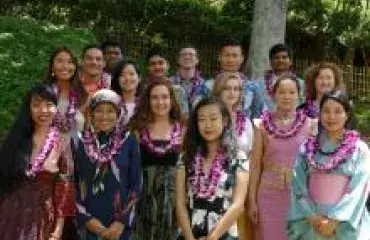
The Thirty-Eighth Summer Seminar on Population coordinated by Senior Fellow Peter Xenos, is comprised of three individual workshops but include common activities providing ample opportunity for professional interaction among all 47 participants. The Seminar featured workshops on three topics: Population, Development, and Policy: The Economic Payoffs of Population Change; Livable Cities in Pacific Asia: Research Methods for Policy Analysis; and Communicating with Policymakers about Population and Health. Information on the Thirty-Ninth Summer Seminar on Population is now available on our website.

The National Oceanic and Atmospheric Administration’s Integrated Data and Environmental Applications (NOAA IDEA) Center has been launched and is yet another example of the EWC’s important role in supporting new regional activities. The NOAA IDEA Center will Advance NOAA’s mission to meet critical regional needs for ocean, climate, and ecosystem information to protect lives and property, support economic development and enhance the resilience of Pacific Island communities in the face of changing environmental conditions.  Initial program elements include: support for regional and global observing systems and programs; development of new integrated data products and environmental applications; and user engagement, education and operation. Eileen Shea is the director of the IDEA Center and she continues her association with the Center as an Adjunct Fellow. 


About Research Projects

East-West Center research projects are multinational and collaborative in nature, involving participants and institutions from the U.S. and the Asia Pacific region. The Center fosters partnerships that address significant, real world problems and disseminates information and analysis to policymakers and the public. It strives to develop innovative collaboration between scholars, scientists and decision makers in addressing the political, economic, demographic, resource and environmental challenges facing the region.

Please see the complete list of research projects, or download a copy of the Research Program brochure in pdf format (31 pages).

 
Unless otherwise noted, all content © East-West Center. All rights reserved.